Key Cardiology Service Line Performance Metrics Every Leader Should Track
Managing cardiovascular service lines requires strictly aligning high-acuity clinical interventions with baseline hospital economics. Executing this financial balance demands rigorous oversight of the cardiology service line performance Metrics. Within these highly specialized departments, relying on legacy reporting or intuition directly threatens operational viability.
Facilities must strictly align clinical outcomes with financial margins. Operating without defined cardiology KPIs immediately degrades executive oversight, forcing reactive management. These metrics establish the rigid operational framework needed to identify inefficiencies and guide strategic service-line growth.
Executing value-based care contracts requires absolute clarity on data. Deploying cardiology analytics directly drives continuous clinical optimization while securing long-term financial performance.
Understanding the Role of Performance Metrics in Cardiology Management
Service-line leaders rely on measurable indicators to run their departments effectively. Cardiology units require high capital investment in equipment like catheterization machines and echocardiogram systems. Management cannot guess if a new lab will generate a return on investment. They need exact numbers.
Cardiology KPIs support clinical decisions by tracking patient recovery trends over time. They support operational decisions by highlighting equipment downtime or staff scheduling inefficiencies. They support financial decisions by revealing the true cost of specific procedures down to the individual surgical supplies used.
Healthcare performance measurement provides direct visibility into these areas. Without these metrics, administrators cannot measure the impact of new clinical protocols or software implementations. A successful cardiology service line management strategy demands a defined set of indicators to evaluate success objectively.
Cardiology service line performance metrics are measurable indicators that help healthcare leaders evaluate clinical outcomes, operational efficiency, and financial performance within cardiology departments.
Categories of Cardiology Performance Metrics
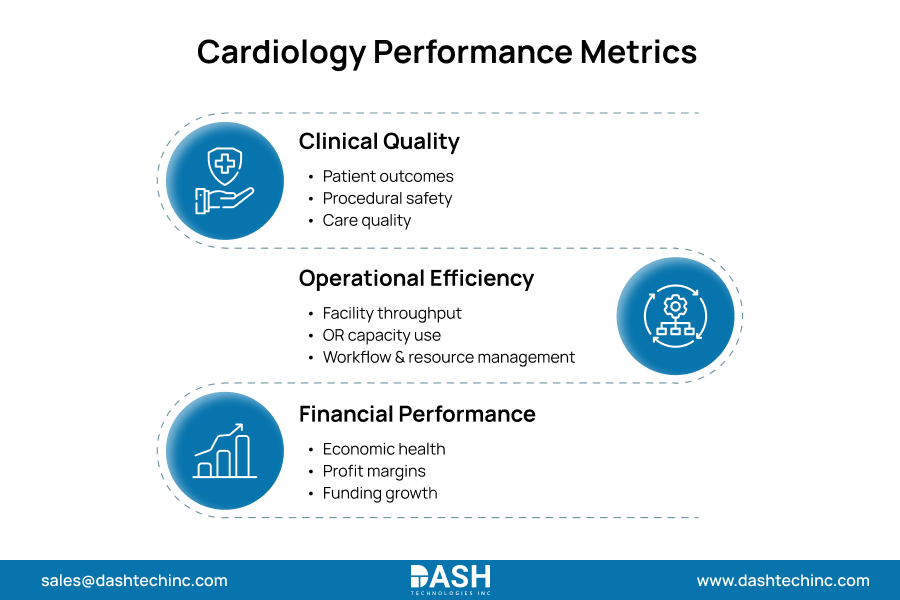
The easiest way to manage cardiology KPIs is to group them into clear categories. This structural approach prevents metric fixation, granting service-line leadership a comprehensive view of departmental performance.
- Cardiology outcomes metrics: Quantifies patient outcomes. It also assesses procedural safety and measures absolute care quality across the cardiovascular service line.
- Cardiology operational metrics: Reveals exact facility throughput. It isolates how efficiently the department allocates OR capacity, manages clinical workflows, and utilizes highly specialized resources.
- Cardiology financial performance metrics: Dictates the fundamental economic health of the program, tracking the exact margins required to fund sustainable service-line expansion.
This structure makes cardiology analytics metrics more useful because it reflects how cardiology actually operates. Strong service lines do not succeed on clinical results alone, and they do not grow on financial results alone. They grow by performing well across all three categories.
Clinical Quality Metrics Cardiology Departments Should Monitor
Tracking strict cardiology outcomes metrics directly dictates patient safety and baseline clinical efficacy. As value-based reimbursement expands, enforcing these standards secures facility margins under strict quality-linked contracts.
Core cardiology quality indicators require continuous executive oversight:
- Mortality Rates: Serve as the definitive benchmark for acute and procedural clinical execution.
- Readmission Rates: Isolate failures in care transitions and post-procedure follow-up, specifically penalizing margins in complex heart failure management.
- Complication Rates: Highlight differences in procedures by doctor and facility. This helps leaders ensure surgical quality is consistent.
- Patient Satisfaction Scores: Quantify care coordination, communication, and operational timeliness. In value-based models, these scores indicate that the facility offers a full care experience. It’s not just about technical interventions.
- Guideline Adherence & Follow-Up Completion: Ensure that all staff follow baseline clinical standards. This should be enforced throughout every part of the cardiovascular care episode
Optimize Your Cardiology Performance
Turn KPIs into actionable insights to improve outcomes, efficiency, and revenue.
Explore Analytics SolutionsOperational Metrics That Improve Cardiology Efficiency
Implementing precise cardiology operational metrics determines the facility’s fundamental capacity. Suboptimal cardiology workflow performance immediately degrades patient access, exhausts specialized clinical staff, and severely restricts procedural room utilization.
Service-line leadership must relentlessly track these core operational indicators:
- Cath Lab Utilization: Quantifies the exact efficiency of procedural capacity allocation.
- Patient Throughput: Exposes the velocity of clinical transitions across all phases of care.
- Length of stay: Helps leaders understand inpatient efficiency and discharge effectiveness.
- Procedure Turnaround Times: Isolates the operational speed of case preparation, execution, and room turnover.
Continuous visibility into these metrics isolates the exact operational bottlenecks restricting programmatic growth. Without tracking true utilization, superficially “busy” catheterization labs routinely leak revenue and strand procedural capacity. Similarly, unchecked discharge delays immediately compromise otherwise high-performing inpatient units, artificially inflating length of stay and destroying shared margins.
Financial Metrics That Drive Cardiology Service Line Growth
Cardiology’s financial performance is closely tied to how well the department manages clinical care and operations. Financial metrics should not be viewed as separate from quality and workflow. In a well-run service line, they reflect how effectively the program converts activity into sustainable performance.
Important financial metrics include:
- Cost per case: Helps leaders understand resource intensity and variation across procedures.
- Contribution Margins: Quantifies the exact financial impact of cardiovascular activity on baseline hospital economics.
- Reimbursement Rates: Exposes payer performance and dictates contract negotiation strategies.
- Procedure Profitability: Identifies which clinical services drive scalable growth and which require immediate operational redesign.
These metrics matter because growth without financial discipline can create strain rather than value. A cardiology department can do more procedures, but if costs go up faster than payments, it may still struggle. Likewise, poor operational efficiency can cause higher staffing costs. It can also lead to longer stays and unused procedural capacity.
The most useful financial measurement approach is one that connects economics to workflow. Cost per case, for example, becomes more actionable when leaders can tie it to case duration, supply utilization, staffing patterns, or readmission trends.
Using Analytics Platforms to Track Cardiology KPIs
Modern cardiology analytics platforms make KPI tracking more useful by centralizing data from multiple systems and presenting it in a form leaders can act on. Rather than relying on static reports from different departments, cardiology dashboards create a more connected view of service-line performance.
These platforms typically support:
- Real-Time KPI Monitoring: Tracking live metrics helps executives fix issues right away. This way, they can prevent performance from getting worse.
- Integrated Data Analysis: Fusing clinical, operational, and financial data in one spot helps ensure accurate strategy execution. This improves teamwork across functions.
- Predictive Performance Insights: Advanced modeling spots upcoming capacity issues, delays in throughput, and financial risks before they affect operations.
This matters because performance management is most effective when it is timely. Monthly reporting may be enough for board review, but it is usually too slow for day-to-day operational improvement. Analytics dashboards help cardiology leaders move from retrospective reporting to ongoing performance management.
Aligning Cardiology KPIs With Strategic Growth Initiatives
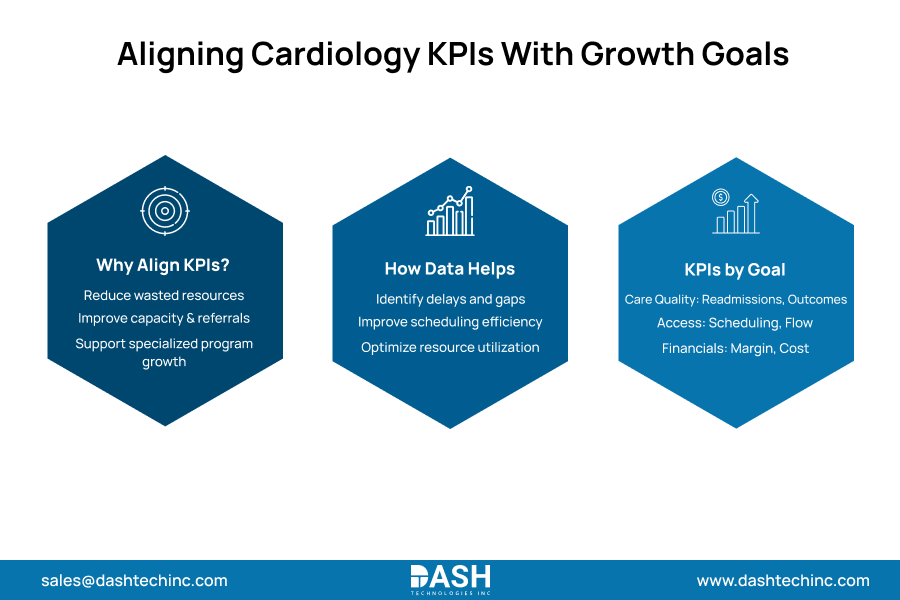
To drive growth in the cardiology service line, it’s essential to align core KPIs directly with executive strategic objectives. Tracking metrics without operational context actively wastes facility resources. Leadership must deploy targeted data to expand procedural capacity, secure referral retention, and scale highly specialized cardiovascular programs.
Enforcing these exact metrics isolates the operational variances, restricting facility throughput. Continuous data visibility improves clinical pathways. It reveals scheduling delays, care handoff issues, and gaps in post-procedure follow-up. This rigorous oversight strictly governs capacity planning, proving whether operations can safely absorb higher procedural volume.
Cardiology performance optimization works best when leaders choose metrics that reflect their strategy. If the goal is to improve access, throughput, and scheduling metrics matter more. If the goal is to strengthen value-based performance, readmissions and outcome metrics become more central. To reach service-line profitability, margin and cost-per-case metrics must be checked. Review these in the context of operational performance.
Conclusion: Data-Driven KPIs Enable High-Performing Cardiology Programs
Executing a rigorous cardiology analytics strategy directly dictates executive success. Achieving absolute cardiology service line optimization requires permanently replacing operational assumptions with strict, objective data governance.
Continuous visibility into targeted performance metrics forces immediate alignment between clinical and administrative leadership. Mandating this structural oversight allows cardiovascular programs to systematically eliminate operational waste, aggressively capture market share, and secure clinical dominance alongside financial efficiency.
For organizations looking to turn these insights into measurable outcomes, connecting with experts can help define the right approach.
Frequently Asked Questions
About Dash

Dash Technologies Inc.
We’re technology experts with a passion for bringing concepts to life. By leveraging a unique, consultative process and an agile development approach, we translate business challenges into technology solutions Get in touch.