How Medical Device Companies Can Scale EHR Integrations Without HL7/FHIR Specialists?
Every medical device company selling into hospitals eventually hits the same wall: the product works and the customer wants it, but connecting it to their EHR takes months and depends on the few engineers who understand HL7 and FHIR well. That combination of healthcare and technical expertise is scarce, and demand for it keeps growing as healthcare technology relies more heavily on standards-based data exchange. Configurable, standards-based integration platforms change that math. Instead of building a new interface for every hospital connection, teams reuse patterns that already work, which means faster onboarding and lower engineering cost per deal, without eliminating the need for interoperability expertise altogether.
Can Medical Device Companies Scale EHR Integrations Without HL7/FHIR Specialists?
Largely, yes. Medical device companies can reduce their dependence on dedicated HL7/FHIR talent by adopting configurable, standards-based HL7/FHIR platforms that package the hardest parts of interoperability, data mapping, message validation, connector logic, into reusable components. Integration staff configures connections instead of coding them from scratch, which shortens onboarding and frees specialists for the work that genuinely needs custom expertise. Some interoperability knowledge in-house still helps; a large dedicated team usually doesn’t.
Key Takeaways
- HL7/FHIR expertise is valuable, but it’s hard to hire and even harder to keep.
- A custom interface for every hospital customer slows sales and drains engineering time.
- Configurable platforms reduce, rather than eliminate, the need for specialist involvement.
- Business and support teams can own common integration tasks when the tooling allows it.
- Evaluating a platform means looking past “custom vs. configurable” to specific criteria: EHR coverage, standards support, mapping, reusability, monitoring, security, deployment, and implementation ownership.
Why HL7/FHIR Expertise Has Become a Bottleneck for Medical Device Companies?
For many medical device companies, hospital onboarding becomes increasingly difficult as EHR integration requirements multiply across customers. Every EHR vendor implements HL7 and FHIR a little differently, so each connection needs someone who understands the standard, not just the acronym.
That combination of healthcare domain knowledge and technical interoperability expertise is difficult to hire and scale. The broader health information technology workforce is growing quickly: the U.S. Bureau of Labor Statistics projects 16% employment growth for health information technologists and medical registrars from 2025 to 2035, with about 3,000 openings projected annually (bls.gov). While this category is broader than HL7/FHIR specialists specifically, the growth highlights the rising demand for healthcare technology expertise generally, and device companies are competing with hospitals, payers, and health tech vendors for the same pool of people.
Day to day, that shows up as hiring cycles that stretch past what sales promised, one or two engineers who end up owning all the interoperability knowledge, and deals that slip because integration can’t keep pace with the contract. This isn’t really a hiring problem. It’s a scalability problem.
The Hidden Cost of Relying on Specialized Integration Teams
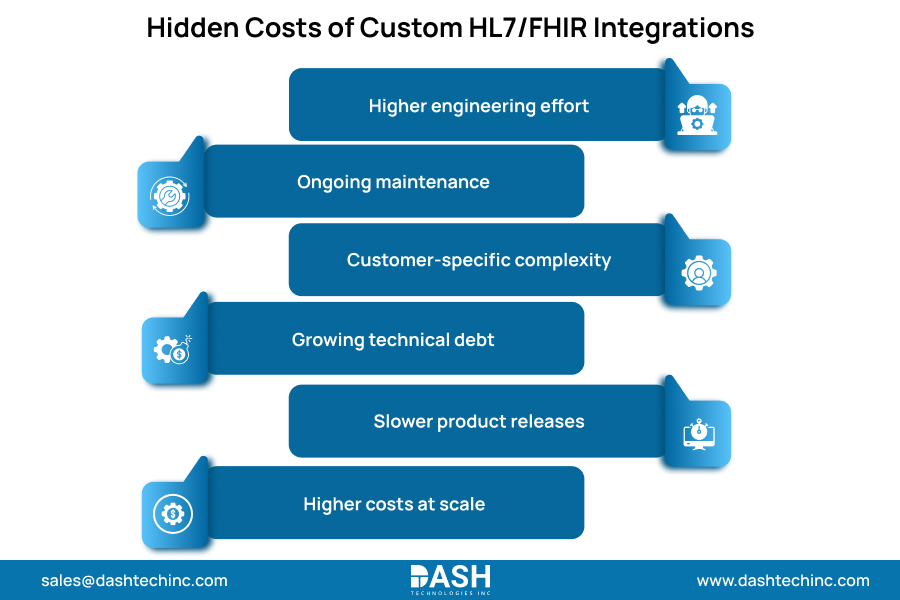
The direct cost of an integration project is easy to see: engineering hours, a project manager’s time, maybe a consultant’s invoice. The hidden cost shows up later, and it’s usually bigger.
When your only FHIR-fluent engineer is buried in one hospital’s custom interface, every other deal waits, onboarding slips from weeks to months, and a competitor gets room to close first. Maintenance piles up too, since interfaces built under deadline pressure need more attention later, not less.
There’s also an opportunity cost that rarely lands on a project tracker: every hour spent re-solving a problem your team already solved elsewhere is an hour not spent on the roadmap.
What We See Repeatedly in Healthcare Integration Projects
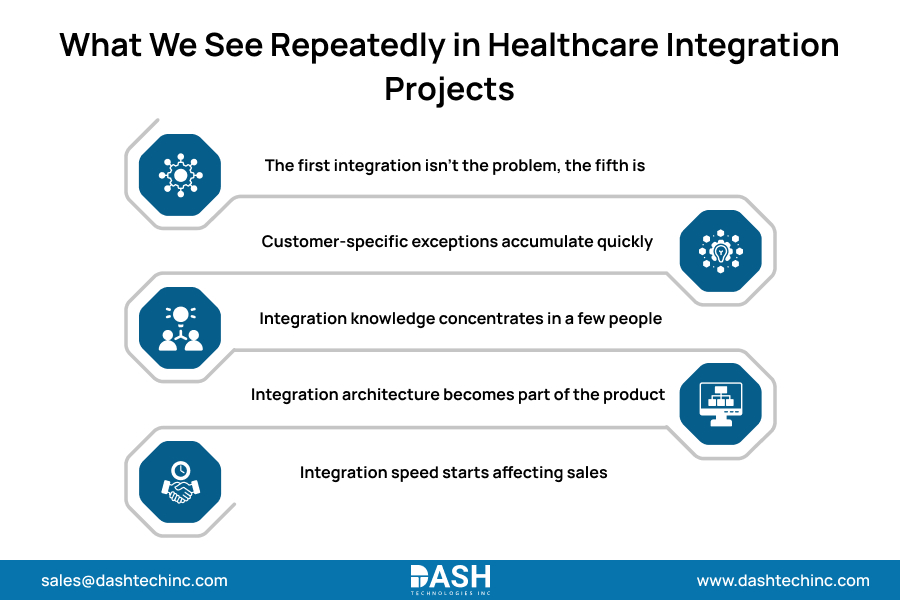
A few patterns show up again and again across healthcare integration work, and they tend to matter more than any single technical decision.
- The first integration isn’t the problem.
The fifth is.A custom interface built carefully for one hospital usually works fine on its own. The trouble starts a few customers in, when a new hospital needs something the original approach was never designed to flex for, and the team realizes the “one-off” solution was never meant to be reused. - Customer-specific exceptions accumulate quickly.
Every hospital’s workflow has a quirk: a different field mapping, an unusual message format, a one-off validation rule. Handled ad hoc, those exceptions pile up into technical debt that makes every future change slower and riskier than the last. - Integration knowledge becomes concentrated in a few people.
Interoperability work tends to fall to whoever solved it last time. After a few projects, that person becomes the only one who understands how the pieces fit together, which creates real key-person risk if they leave or move to a different team. - The integration architecture eventually becomes part of the product.
For a medical device company, EHR connectivity stops being a one-time implementation task and becomes a feature customers expect at every new site. At that point, the integration approach needs the same durability and reusability as any other part of the product, not the “just get it working” treatment of a one-off project. - Integration speed starts affecting sales.
Once EHR connectivity becomes a standard expectation, how quickly a company can stand up a new connection starts to show up in the sales cycle itself. A slow, unpredictable integration timeline can stall a deal as much as a missing product feature can.
Why Configurable HL7/FHIR Platforms Change the Economics of Integration?
A configurable platform doesn’t remove the need for HL7/FHIR knowledge. It changes who needs that knowledge day to day, and how often they have to apply it from scratch.
Instead of writing a new interface engine for every hospital, teams work from reusable connectors and a standards-based HL7/FHIR architecture that already handles the plumbing: message parsing, data mapping, validation, error handling. Guided configuration lets a team point the platform at a new EHR endpoint and adjust settings instead of writing new code line by line. What used to take a specialist weeks becomes a task a smaller team finishes in days, which means faster rollout, faster time to revenue, and fewer specialists tied up maintaining old interfaces.
| Evaluation Criteria | Traditional Custom Integration | Configurable HL7/FHIR Platform |
| Dependence on Specialists | High | Low |
| Time to Onboard New Customers | Longer | Faster |
| Engineering Effort | High | Lower |
| Reusability | Limited | High |
| Business User Participation | Minimal | Greater |
| Maintenance | Complex | Simplified |
The pattern holds across nearly every criteria a technical buyer cares about: less specialist dependence, faster onboarding, simpler upkeep.
What Should Medical Device Companies Evaluate in an EHR Integration Platform?
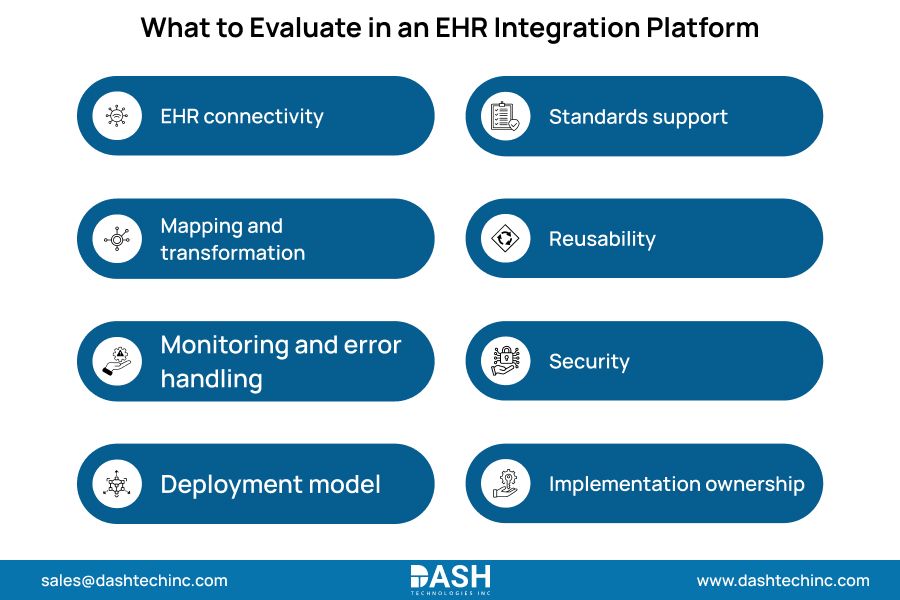
“Custom vs. configurable” is a useful starting comparison, but it’s not enough on its own to evaluate a real platform. Here’s the framework worth working through with any option under consideration:
- EHR connectivity.
Which EHR systems does the platform already support, and how deep does that support go? Epic, Oracle Health (formerly Cerner), MEDITECH, and athenahealth each implement HL7 and FHIR a little differently, and generic standards support doesn’t always mean vendor-specific work is already solved. - Standards support.
Does the platform handle HL7 v2 as well as FHIR, along with the API and authentication requirements each EHR imposes? Most hospital environments run a mix of older HL7 v2 interfaces and newer FHIR APIs, not one or the other exclusively. - Mapping and transformation.
Can your team handle customer-specific field mappings through configuration, or does every hospital’s quirks require touching the underlying integration code? - Reusability.
Does the same integration pattern genuinely get reused for customer #2, #10, and #50, or does each new hospital start from a modified copy of the last one? - Monitoring and error handling.
How are failed messages, API errors, and data mismatches surfaced? A platform that fails silently creates more support burden over time than one that fails loudly and early. - Security.
Authentication, authorization, audit logging, and PHI handling need to hold up under the same scrutiny a hospital’s own systems face, not a lighter version of it. - Deployment model.
Does the platform run in the cloud, in the customer’s environment, or some hybrid of both? This affects implementation timelines and what your customers’ IT and security teams will need to sign off on before go-live. - Implementation ownership.
For a given task, does it require engineering, or can it be handled through configuration by a support or implementation team? This is often the clearest signal of how much a platform actually reduces specialist dependence, versus simply repackaging it under a different name.
Empowering Business and Support Teams to Build Interfaces
Here’s the catch most engineering leaders miss: not every integration task needs an engineer. Adding a field mapping or adjusting a connection for a hospital’s workflow can be handled by business or support staff, if the tooling is built for people who aren’t writing code.
Guided configuration and reusable templates make that possible. A support team member can work through a standardized workflow to set up a common pattern, freeing engineers for the parts of the job that genuinely need deep FHIR knowledge. This isn’t about replacing developers. It’s about matching the skill to the task, so a mapping issue can get fixed the same day instead of waiting in an engineering queue.
Build, Buy, or Configure: A Decision Framework
The right approach depends less on company size than on the shape of the integration problem in front of you.
| If your situation is… | Consider |
| One or two highly specialized integrations | Build |
| Large enterprise integration ecosystem | Buy |
| Multiple EHRs and a growing customer base | Configure |
| Strong interoperability team with unique requirements | Build |
| Limited integration expertise and fast growth | Configure |
| Hundreds of interfaces with dedicated integration operations | Buy |
Most medical device companies scaling into new hospital customers land in the “configure” row: multiple EHRs, a growing customer base, and not quite enough in-house interoperability depth to build and maintain everything from scratch, but not so much scale yet that a fully bought, hands-off platform fits either.
How BridgeFast Helps Lean Teams Scale Healthcare Integrations?
This is where BridgeFast fits. Built on Dash Technologies’ years of HL7 and FHIR implementation work, BridgeFast packages the hard parts of interoperability into reusable components that a lean engineering team can configure instead of build from scratch.
New hospital connections move faster, since BridgeFast starts from proven, standards-based patterns instead of a blank page. Implementation stays predictable because the architecture is consistent across customers, even when each hospital’s EHR setup looks a little different. As the number of hospital customers grows, reusable integration patterns can reduce the need to scale interoperability resources at the same rate.
Need a faster approach to EHR integration?
BridgeFast Accelerator combines proven interoperability frameworks with prebuilt EHR connectors to help organizations reduce custom development and accelerate healthcare integrations.
Talk to Our Integration ExpertThe Case for Configurable Healthcare Integration
Healthcare interoperability is moving toward more standardization, though not uniformly. FHIR is HL7’s standard approach for exchanging health data (hl7.org), and federal data shows real progress: as of 2024, about 9 in 10 hospitals let patients access an app through an API, and roughly 7 in 10 did it through a standards-based FHIR API, largely because the ONC Cures Act rule has required certified EHRs to expose standardized FHIR APIs since January 1, 2023 (healthit.gov).
But FHIR adoption expanding doesn’t mean healthcare integration is becoming FHIR-only. The same ONC data shows that when hospitals exchange clinical and administrative data with third-party technology more broadly, beyond patient-facing apps, most of that exchange still happens through proprietary APIs and non-API methods such as HL7 interfaces, not standards-based FHIR APIs (healthit.gov). That’s exactly why a platform built to handle HL7 v2 and FHIR side by side, rather than assuming everything will eventually be FHIR, tends to hold up better in practice. Reusable interoperability assets, not bigger interoperability teams, are becoming how healthcare technology companies keep pace with hospitals that want faster onboarding, regardless of which standard a given connection ends up using.
Conclusion
Hiring more HL7/FHIR specialists isn’t the only way to scale healthcare integration, and it might not even be the best one. Standardized, configurable approaches improve speed, cost, and maintainability at the same time, a rare combination in engineering. BridgeFast gives lean teams a way to cut that complexity now while building toward growth that doesn’t depend on winning the talent market.
Scale Healthcare Integrations Without Scaling Your Integration Team
BridgeFast combines Dash Technologies’ interoperability expertise with configurable, standards-based HL7/FHIR capabilities that help medical device companies accelerate EHR integrations, reduce dependency on specialized engineers, and support sustainable growth.
Explore BridgeFast Talk to a Healthcare Interoperability Expert
Frequently Asked Questions
About Dash

Dash Technologies Inc.
We’re technology experts with a passion for bringing concepts to life. By leveraging a unique, consultative process and an agile development approach, we translate business challenges into technology solutions Get in touch.